
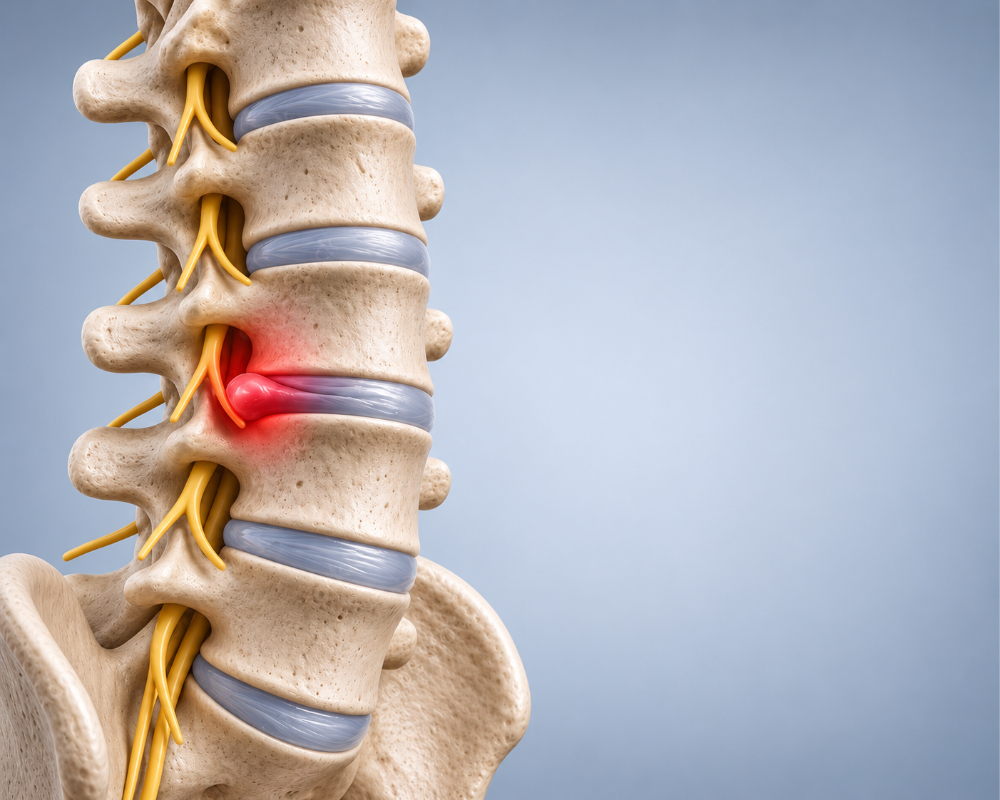
You’ve been told you have a bulging disc. Maybe it turned up on an MRI report after weeks of back pain, or someone suggested it after you felt a sharp pain while lifting.
Now you’re wondering whether you should stop exercising, avoid bending or start preparing for surgery.
Disc bulges also appear on scans of people with no back pain. We assess whether the finding fits your symptoms and whether a nerve is involved.
Most people with disc-related pain get better without an operation. We want to understand how the symptoms are affecting you and what you need to get back to doing.
The question we hear most is, “Is my back damaged for good?”
Words like “degeneration” and “protrusion” sound alarming on a report, but they describe what the disc looks like, not how strong your back is or how well it can recover.
We go through your report with you, so you know which findings relate to your symptoms and which are just part of a normal, ageing spine.
What’s the difference between a bulging disc and a herniated disc?
Discs sit between the bones of your spine, called vertebrae. They spread load and allow your back to move. Think of each disc as a tough outer ring with a softer, gel-like centre.
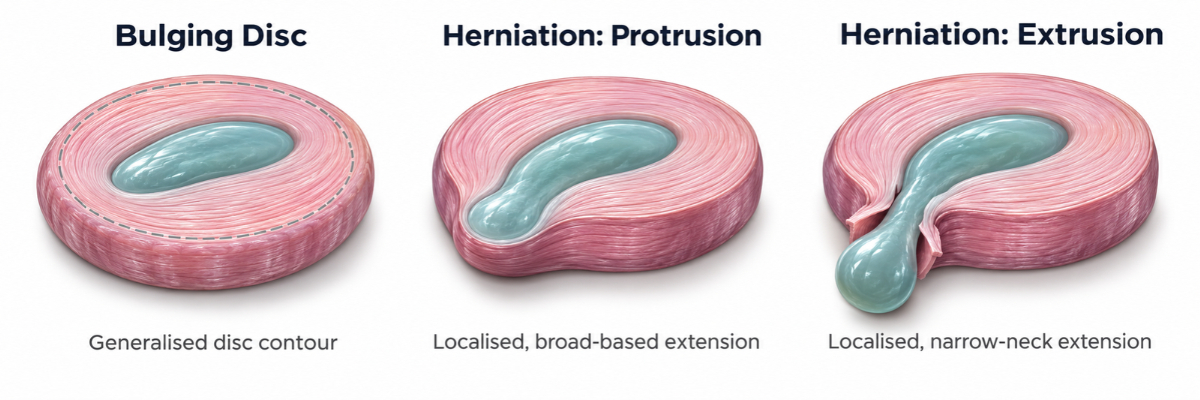
A bulge is a broad extension of the disc beyond its usual boundary. A herniation is a more localised displacement of disc material.
| Term | What it describes |
|---|---|
| Bulging disc | The disc extends beyond its usual edge over a broad area |
| Herniated disc | Disc material extends beyond its usual boundary in a more localised area |
| Protrusion or extrusion | Terms describing the shape of a disc herniation |
Radiologists use these terms according to the spinal societies’ disc terminology recommendations. Outside a scan report, you’ll hear them used interchangeably.
“Slipped disc” is another common name, and a misleading one. The disc stays attached between the vertebrae. It hasn’t slid out of place.
Labels such as L4–L5 and L5–S1 tell you which level of the lower back is involved. The level alone doesn’t tell you how painful it is or what treatment you need.
Does a disc bulge always cause pain?
No. Disc changes are common as we age, including in people who feel no pain.
A 2015 review of scans from 3,110 people without symptoms estimated disc bulges in 30% of 20-year-olds, rising to 84% by age 80. Disc protrusions appeared across the age groups too.
The bulge on your report could be relevant to your symptoms, or it could have been sitting there quietly for years. We check whether the scan matches where you hurt, the pattern of any leg symptoms and what we find on examination.
Bring your report if you have one. The wording deserves an explanation before it starts making decisions about your life.
What symptoms can a herniated disc cause?
A disc problem can cause lower-back pain or irritate a nearby nerve root and send symptoms into the buttock or leg.
Symptoms include:
- Back pain aggravated by particular movements or prolonged sitting
- Sharp, burning or shooting leg pain
- Pins and needles or numbness
- Weakness in part of the leg or foot
- More pain when you cough, sneeze or strain
Leg pain from an irritated nerve root in the lower back is often called sciatica. Your back pain can be mild, or missing entirely, even when the leg pain is significant.
Tell us about any change in strength or feeling in your leg. Weakness and numbness shape what we examine and how closely we track your recovery. Better Health Channel’s disc information explains the symptoms and assessment.
When to get urgent help
Seek emergency medical assessment immediately if you have back or leg symptoms with:
- New difficulty starting urination, being unable to empty your bladder or loss of bladder control
- New loss of bowel control
- Numbness around the genitals, anus or inner thighs, known as the saddle area
- Severe or rapidly worsening leg weakness
These can be signs of serious nerve compression, including cauda equina syndrome. Go to an emergency department. Call triple zero (000) if symptoms are severe or you can’t travel safely. Don’t wait for a routine appointment.
You should also see a doctor promptly for back pain after significant trauma, or back pain with fever, feeling unwell, unexplained weight loss or a history of cancer.
Healthdirect’s spinal disc guidance explains when urgent care is needed.
What should I do for a bulging disc?
If you don’t have any of the warning signs above, keep moving at a manageable level. Bed rest feels sensible when your back is sore, but long periods lying down make getting back to normal harder.
The Australian Low Back Pain Clinical Care Standard encourages staying active and returning to usual activities, including work, as soon as feasible.
Start with what you can do. Short walks, regular changes of position and breaking bigger jobs into smaller pieces are practical options. If sitting brings on leg pain, change position or walk briefly before it builds.
During a flare-up, ease back on movements that sharply increase your pain, then build back up as things settle. Bending and lifting belong in your recovery. We help you work towards the range and load your daily life involves.
Tell us whether an activity changes how far the pain travels down your leg. We use that response, alongside strength and sensation testing, to guide exercise selection. Increasing weakness or new numbness needs reassessment.
Speak with your GP or pharmacist if you need pain relief to sleep or move.
Jobs like vacuuming, hanging out the washing or weeding the garden can be tough during a flare-up. Rather than avoiding them, try doing them in shorter bursts, kneeling or using a stool for low jobs, and keeping things close to your body as you reach or lift.
A good guide is how you feel over the next 24 hours. If your pain hasn’t increased and it isn’t spreading further down your leg, that’s generally speaking a green light to do the same amount again, or a little more, and gradually get back to bending the way you normally would.
How does physiotherapy help a bulging or herniated disc?
We start with your story: where the pain travels, what’s changed, how you’re sleeping and which jobs have become difficult. If you have leg symptoms, we check strength, sensation and reflexes where appropriate.
That helps us decide whether to start rehabilitation straight away, refer you for medical review or keep a close eye on particular findings. Weakness that’s getting worse needs a different response from back pain on its own.
If it’s back pain alone, we usually start active rehab straight away and focus on getting you moving with confidence. If pain travels into your leg but your strength and feeling are normal, we still get you moving, but we recheck your strength, sensation and reflexes at each visit, and how far down the leg the pain goes helps guide your exercises.
If we find weakness that’s getting worse, we don’t wait and see. We’ll arrange a prompt review with your GP or a specialist, and possibly a scan, alongside your physio care.
Early sessions focus on managing symptoms and keeping you moving through your day. As your back settles, we increase the load and work towards whatever you need to get back to, whether that’s picking up your kids, getting through a full day at your desk or returning to the gym.
Our lower-back physiotherapy service in Adelaide covers assessment and rehabilitation. If your symptoms run into your leg, our sciatica treatment information explains that in more detail.

Which exercises help a bulging disc?
There’s no single routine that suits every disc presentation. A movement that settles one person’s leg pain can aggravate someone else’s. We choose exercises from your assessment and check how you respond before progressing them.
Early on, that often means:
- Walking, starting with short, frequent bouts
- Gentle spinal movements selected according to your symptom response
- Nerve mobility exercises where assessment shows they are appropriate, with guidance on range and dosage
Later, we build strength through the trunk, hips and legs with exercises such as bridges, squats, step-ups and deadlift variations, working towards the bending and lifting your life involves.
If an exercise brings on new numbness, increasing weakness or a clear worsening of leg pain, stop and get advice. More repetitions won’t rescue an exercise that’s wrong for your back right now.
Do I need an MRI for a bulging disc?
Most new episodes of lower-back pain don’t need a scan. An MRI is useful when the result will change what happens next: when serious pathology is suspected, when nerve function is deteriorating, or when disabling leg symptoms haven’t settled and an injection or surgery is being considered.
Given how common disc changes are in people without pain, matching scan findings to your symptoms matters. Ask what question the scan is intended to answer.
The RACGP’s explanation of lumbar MRI discusses its benefits and limitations.
How long does a bulging disc take to recover?
Many people improve over weeks to months. Sciatica can take longer, and we monitor strength and sensation alongside pain. NHS guidance describes this variable recovery.
Herniated disc material often shrinks as the body reabsorbs it. A 2017 meta-analysis reported this in roughly two-thirds of lumbar disc herniations studied. A separate systematic review found regression was more likely with extruded or sequestered discs than with protrusions or bulges. These findings describe changes on imaging; they don’t predict an individual’s recovery time.
We track what matters day to day: how far you can walk, how you’re sleeping, how long you can sit and whether your strength is coming back. If those stall, we review the plan.
Will I need surgery for a herniated disc?
Most people with a lumbar disc herniation improve without it.
A specialist opinion becomes worthwhile when severe leg pain persists despite appropriate non-surgical treatment, or when nerve function is declining. Severe or progressive weakness and cauda equina symptoms need urgent assessment.
For selected patients, surgery removes disc material pressing on the nerve and offers faster relief from leg pain. The decision brings together symptoms, examination findings, imaging and your goals. AAOS guidance explains the surgical and non-surgical options.
Book a back assessment in Highgate
A disc finding can be worrying. We’ll explain how it relates to your symptoms and what to do next.
If back or leg pain is getting in the way of work, sleep or training, we can assess what’s going on, check your nerve function where needed and build a plan to get you moving again. If you need further investigation, we’ll tell you.
Call 8490 0777, book your physiotherapy appointment online or email [email protected].